
CRD Allergy Test in Delhi: Pinpoint Your Exact Allergy Triggers
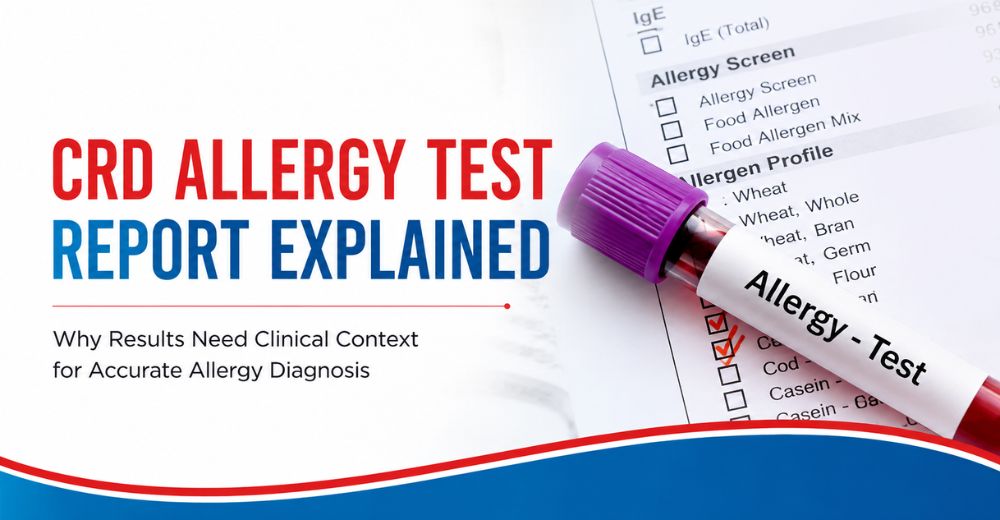
An allergy report can be hard to interpret. Many foods, pollens, or inhaled substances may be pinpointed, but your symptoms may have a different focus. You may have ceased eating certain foods, and this may not have reflected a change. You may also find that your allergy symptoms like seasonal coughing, sneezing, and skin reactions continue to persist after allergy testing.
Many people wanting to have a CRD Allergy Test conducted in Delhi are looking for a better explanation regarding what their allergy report is telling them.
CRD stands for Component Resolved Diagnostics. This is a blood test for allergies that looks at specific different components of allergens and then describes the corresponding IgE antibodies.
CRD is a better allergy test than many of the other ones available, because, instead of saying that the patient has a positive allergy for something, this test says what component the patient’s immune system has recognized.
Despite this fact, the report generated from this test is not enough to make a diagnosis of a clinical allergy. This information has to be compared to a patient’s symptoms and the history of allergen exposure and reactions.
Why a Positive Allergy Result Requires Clinical Context
Allergy blood tests look for antibodies by testing allergen-specific immunoglobulin E, commonly written as specific IgE, or sIgE.
If a test is positive, it indicates that the body produces IgE antibodies for that allergen, and this is known as sensitisation.
Allergy and sensitisation are not the same.
While someone may be sensitive to a food, they could be symptomless and continue to eat that food. Another person could test positive for several allergens due to a protein having a similar structure to several allergens.
Because of this, doctors know they have to look outside the lab value and may ask.
-
What symptoms did the patient experience?
-
How long after exposure did symptoms start?
-
Has the same reaction occurred more than once?
-
How much of the food or allergen did the patient consume?
-
Is the patient able to eat and/or drink this food?
-
Do the symptoms occur in a certain season?
-
Is the patient exposed to dust, pollen, mould, and/or animals?
-
What did previous allergy tests show?
-
Was the patient on medication and/or the same medication?
A specific IgE test result that is positive could mean that the patient has an allergy, but without matching the clinical history, it must not be considered proof.
Component Resolved Diagnostics (CRD) Explained Simply
Traditional Allergy blood tests typically apply an extract made from an entire allergen source, like milk or peanuts, or even pollen or house dust mites.
Among an allergen extract are many proteins. When a blood test shows a positive response, the doctor is made aware that the immune system has identified something among that extract. However, it is often the case that the response is not specific to that one protein.
Component Resolved Diagnostics studies the source in even more detail.
The term component is in reference to an individual allergen molecule, which is generally a protein. Resolved refers to the process of subdividing a broader allergen source in order to study the individual molecular components
For example, a particular extract-based allergy profile may show that an individual is sensitized to a particular food. With CRD, the particular food may be broken down and assessed for the individual proteins.
This molecular detail can help doctors understand whether the result may relate to:
-
Primary sensitization to a particular allergen source
-
Cross-reactivity among proteins that are similar
-
Independent sensitization patterns
-
Food and respiratory allergens that are related and contain the same components
-
A particular allergy profile that requires additional explanation
Component Resolved Diagnostics(CRD) does not replace traditional allergy testing. The presence of proteins at the component level helps when clarifying the allergy report that is complex and uncertain.
Cross-Reactivity and Primary Sensitisation in Reports
Primary sensitisation is a process that leads the immune system to generate specific IgE antibodies for proteins linked to a certain allergen.
Cross-reactivity occurs when proteins that come from various allergen sources are structurally similar. Thus, IgE antibodies formed in reaction to a certain protein can identify a protein of a differing allergen source.
This is one reason an allergy report may show several positive results.
Proteins that are similar can be found in different:
-
Types of pollen
-
Pollens and plant-based foods
-
Nuts and seeds
-
Mites and certain seafood
-
Different animals
-
Fruits and vegetables
While several sources may show positive findings, this does not indicate that each of these sources is a cause of allergy symptoms.
CRD may provide additional information to show physicians the molecular components that are linked to each finding, this may establish whether sensitization is primary, is cross-reactivity, or is sensitization to multiple allergens.
An allergy report contains several findings, however, the patient's response to allergens is the primary focus for clinical assessment.
Inside Star Imaging’s 300-Allergen CRD Profile
Star Imaging and Path Lab offers an extensive CRD-based Allergy Profile that requires only one blood sample for multiple tests.
Based on the information provided by Star Imaging, the test includes:
-
300 total allergen entries
-
218 molecular allergens
-
82 purified allergen extracts
-
145 allergen sources
-
85 allergen families
-
107 exclusive allergens
Among these 300, 218 are molecular allergens and 82 are extracted purified allergens. It does not necessarily translate to 300 unique sources of allergens or 300 confirmed allergies.
Molecular allergens
As a component of an allergen, molecular allergens are helpful to a physician to assess sensitisation of an individual at the level of the protein.
Purified allergen extracts
An extracted allergen would contain all the proteins of the complete allergen source. Extracts are informative to sensitisation of foods, pollens, mites, allergens, etc.
Allergen sources
The 145 sources are allergens in foods, pollens, mites, moulds and in other materials.
Allergen families
Allergens that contain proteins of the same structure may be members of an allergen family, and studying these families may help detect cross-reactivity.
It is possible for a person to experience a number of positive sensitisation results without having symptoms after exposure to all or any of the sources. The information provided by Star Imaging is also consistent with a 300-allergen molecular profile that contains 218 molecular allergens and 82 extracts.
Food and Respiratory Allergens Within the Profile
The full allergy profile consists of multiple allergens and includes extracts from food and from inhaled and other allergens.
The food related sources may include:
-
milk
-
egg
-
peanut
-
tree nuts
-
seeds
-
wheat
-
other cereals
-
soy
-
fish
-
shellfish
-
fruit
-
vegetable
-
some spices
Inhaled allergen sources may include:
-
house dust mites
-
storage mites
-
tree, grass, and weed pollen
-
moulds
-
animal dander
-
some insect allergens
Just because a food or a respiratory allergen is in the profile, does not indicate that they elicit a response in all patients that show a positive result. Each component must be related to the patient’s exposure and response in order to elicit a clinical significance.
CRD is also an IgE-allergy investigation, and it should not be marketed as a test for each and every digestive complaint or food-related sensitivity or intolerance.
Clinical Situations Where CRD Testing May Help
A detailed CRD profile could assist some clinicians when a patient presents with a complex or ambiguous sensitization pattern.
This could assist patients that have:
-
Repeated symptoms resembling an allergy but not obvious triggers
-
Reported multiple positive allergens previously
-
Reported allergen findings inconsistent with the reported symptoms
-
Suspected cross-reactivity
-
Non-specified food-related allergic symptoms
-
Respiratory symptoms that are triggered at different times and in different places
-
Both food-related and respiratory allergy symptoms
-
a number of ambiguous allergic sensitivities
-
Symptoms persisting after the suspected trigger was removed
-
Previous allergy reports that were inconclusive
-
The need to provide a component-level approach to allergy management
A persistent cough, skin rash, or stomach complaint cannot be assumed to be an allergy. There are a number of medical conditions that can have similar symptoms. The clinician can make the decision to refer for an allergy assessment based on the history.
The goal of CRD is NOT to provide the longest possible list of positive allergens. The goal is to provide a molecular framework to assist clinicians in exploring a patient'sA detailed CRD profile could assist some clinicians when a patient presents with a complex or ambiguous sensitization pattern.
Reading a CRD Report Alongside Your Symptoms
A CRD report can show allergen names, molecular components, protein families, and specific IgE values. These can be hard to decipher without a medical background.
When reading the report, a doctor may verify the following:
-
Whether a positive result matches the patient’s symptoms
-
Whether the patient has reacted after actual exposure
-
How quickly the symptoms appeared
-
Whether the reaction has happened more than once
-
Whether the person currently tolerates the food
-
Whether several positive results may come from cross-reactivity
-
Whether the symptoms are seasonal or present throughout the year
-
Whether another medical condition may explain the symptoms
-
Whether any additional investigation is needed
A report that shows a higher specific IgE does not equate to a more severe reaction in the future. The value should always be assessed with a clinical framework.
A patient shall not:
-
Use a positive report as the sole reason to eliminate multiple foods
-
Reintroduce foods without medical advice
-
Conduct self-experiments to validate a food reaction
-
Assume all components will cause a reaction just because they are positive
-
Change medications without revising with physicians
-
Use the report to assess and predict the severity of a reaction
Whenever possible, take older documents pertaining to allergies, medications, and details about previous reactions to your physician to discuss the findings.
CRD Allergy Test in Delhi at Star Imaging
Star Imaging and Path Lab provides a detail-oriented CRD-based Allergy Profile for patients interested in the sensitization of IgE at the molecular level.
This profile uses a single blood sample to analyze:
-
The individual molecular allergens
-
Purified allergen extracts
-
The sources of food allergens
-
The sources of respiratory allergens
-
Allergen-related families
-
Patterns of potential sensitization and cross-reactivity
Patients based in Delhi are welcome to contact Star Imaging to verify the current cost of the test, the available centers, preparation details, sample information and the anticipated time for results to be reported.
Book or Enquire About the CRD Profile
For inquiries related to the CRD Allergy Test in Delhi, contact:
Star Imaging and Path Lab
Phone: 011-4560-2200 or 011-4560-2225
Email: info@starimaging.in
Patients are advised to check the availability and sample collection details from the Star Imaging team before visiting a center.
An allergy report must not install a fear of more foods, pollens or other substances. It should assist the doctor in understanding which findings correlate to the patient’s symptoms.
CRD offers a better understanding of the components of allergens. The information provided is best analyzed when a doctor correlates the details with the patient’s symptoms and past reactions and records.
Frequently Asked Questions About CRD Testing
1. What is the complete form of CRD when used in allergy testing?
CRD is an abbreviation for Component Resolved Diagnostics. It is an allergy blood test that examines the sensitization of IgE to specific allergens and selected allergen extracts.
2. How is CRD different than a routine allergy profile?
Routine allergy profiles may evaluate IgE for whole allergen extracts. CRD uses a component-resolved approach, allowing for more precise interpretation of the sensitization pattern for different allergen components.
3. A positive CRD result means an allergy?
No. A positive result indicates sensitization to the component or extract, but a physician can only determine a clinical allergy after correlating this result with the symptoms, exposure, and the history of reactions.
4. What is included in the 300-allergen profile?
Star Imaging’s profile contains 218 molecular allergens and 82 purified allergen extracts, totaling 300 allergens from 145 different sources and 85 allergen families.
5. Does a 300-allergen result mean I have 300 allergies?
No. The number indicates the extent of the profile, not the number of clinical allergies a person may have.
6. Can the test determine the cause of your allergic reaction?
Although the test indicates sensitization to particular allergen components, it cannot establish the precise cause of a reaction without the context of the patient’s symptoms and exposure.
7. Can CRD study food and respiratory allergens?
Yes. The complete profile contains components and extracts of food and inhaled allergens. A physician must use the context of the patient’s symptoms to evaluate the findings.
8. Is the CRD profile done with blood?
Yes. Star Imaging’s CRD-Based Allergy Profile studies multiple molecular allergens and allergen extracts using blood samples.



.jpg)

.png)
.png)


Comments List