
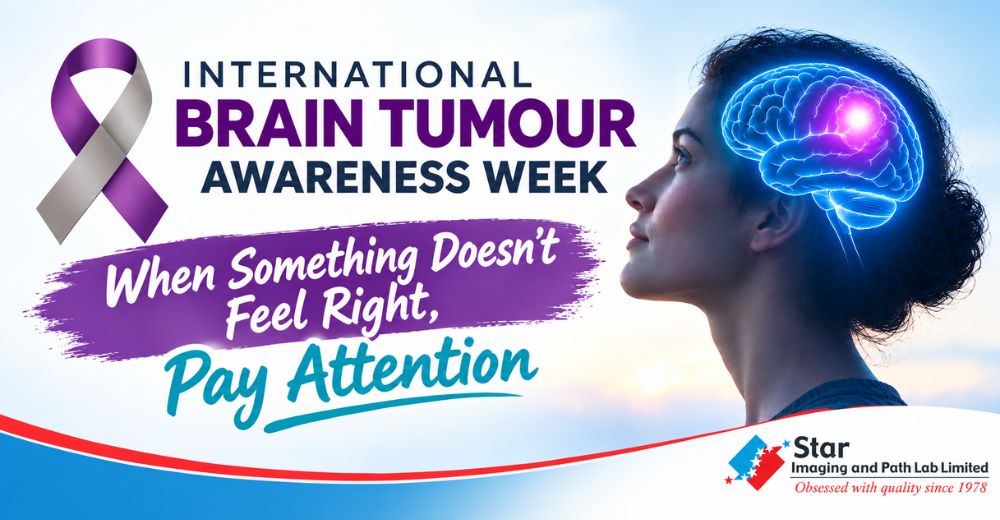
International Brain Tumour Awareness Week: When Something Doesn't Feel Right, Pay Attention
The Changes We Notice, and the Ones We Keep Putting Off
Most of us have days when a headache refuses to go away, concentration becomes difficult, or we feel unlike ourselves. We usually have an explanation ready. Perhaps it is a lack of sleep, a demanding week, too much screen time or simply exhaustion. More often than not, there is a straightforward reason. But when something feels different from usual, keeps returning or gradually gets worse, it deserves our attention.
Brain tumour symptoms are not always easy to recognise because they can vary considerably from one person to another. A change in vision, repeated headaches, difficulty with balance, unexplained vomiting, seizures or changes in memory and behaviour can have several possible causes. These symptoms do not automatically mean someone has a brain tumour. However, persistent or unusual changes should not be dismissed without medical advice.
Why Brain Tumours Deserve a More Informed Conversation
A brain tumour is not one single condition with the same outcome for everyone. Some tumours are non-cancerous, while others are malignant. Their effects depend on several factors, including their type, size, location and how they grow. Even a non-cancerous tumour may need medical attention if its position affects important functions such as movement, speech, vision or memory.
This is what makes awareness important. The concern is not that every headache should lead to a brain scan, or that every change in behaviour signals a serious illness. It is that people should know when a symptom needs attention and feel comfortable discussing it with a qualified doctor rather than repeatedly putting it aside.
What Happens When a Doctor Recommends a Brain MRI?
For someone who has never undergone a brain scan, the recommendation itself can bring a wave of questions. Why is the scan needed? What will it show? Does being referred for an MRI mean something serious has already been found?
A brain MRI, or magnetic resonance imaging scan, uses magnetic fields and radio waves to produce detailed images of the brain. It can help doctors examine unusual areas, assess changes in brain tissue and understand whether a finding requires further investigation. Depending on the clinical situation, a CT scan or other tests may also be appropriate.
An MRI is an important part of investigating a suspected brain tumour, but a scan alone does not always establish the exact tumour type. Doctors interpret the images alongside symptoms, medical history and other findings. In some cases, additional tests or a biopsy may be needed before a diagnosis can be confirmed.
It is equally important to remember that being advised to undergo an MRI does not mean a brain tumour has been diagnosed. The purpose of the investigation is to understand what may be causing the symptoms and determine the appropriate next steps.
The Importance of Taking Concerns Seriously
A possible brain tumour affects more than the person experiencing symptoms. Families may find themselves searching for answers, accompanying someone to appointments and trying to make sense of unfamiliar medical terms. Waiting for reports can be stressful, particularly when there are more questions than answers.
Clear communication matters throughout this process. Patients should feel able to describe what they have noticed, ask why a particular investigation is recommended and seek clarification about their results. Equally, diagnostic imaging should be approached with care, attention to clinical details and an understanding of the questions the referring doctor needs answered.
If you or someone close to you experiences persistent, worsening or unusual neurological symptoms, arrange a medical assessment. A sudden, extremely severe headache or a first seizure requires emergency medical attention.
This International Brain Tumour Awareness Week, Start With Awareness
International Brain Tumour Awareness Week is an opportunity to look beyond a diagnosis and recognise the people navigating the uncertainty that comes with it. It is also a reminder that meaningful awareness involves more than sharing facts. It means listening when someone says they do not feel right, taking their concerns seriously and helping them find appropriate medical guidance.
We may not always know what a symptom means. But we can choose not to ignore it, not to jump to conclusions and not to leave important questions unanswered. Sometimes, that is where a more informed decision begins.
Frequently Asked Questions
Question: Can a person have a brain tumour without experiencing headaches?
Answer: Yes. Headaches are not present in every case, and some brain tumours may initially cause no noticeable symptoms. Others may affect vision, balance, movement, speech, memory or behaviour, depending on their location and growth. The absence of headaches does not rule out a brain tumour.
Question: Does every suspected brain tumour require an MRI scan?
Answer: No. The appropriate investigation depends on the person's symptoms, clinical examination and medical history. A doctor may recommend an MRI, a CT scan or other investigations depending on the circumstances. MRI is commonly used for detailed assessment of suspected brain tumours.
Question: Can an MRI scan confirm whether a brain tumour is cancerous?
Answer: An MRI can reveal the location, size and imaging characteristics of a suspected tumour, helping doctors assess its nature. However, imaging may not establish its exact type or whether it is malignant. Further assessment, and sometimes a biopsy, may be necessary.
Question: If an MRI report mentions a lesion or mass, does that automatically mean cancer?
Answer: No. A lesion or mass is a descriptive finding, not a definitive cancer diagnosis. Some findings are non-cancerous, and others may require additional investigation. The report should be interpreted by the treating doctor in the context of the person's symptoms and clinical history.
Question: Should a person get a brain MRI as a precaution without symptoms?
Answer: Routine brain MRI screening is not generally recommended for every person without symptoms or specific risk factors. Unnecessary scans can reveal incidental findings that may lead to further tests and anxiety. The decision should be based on medical advice and individual circumstances.











Comments List