
Influenza A vs B | Which Test Confirms Flu Type A or B?
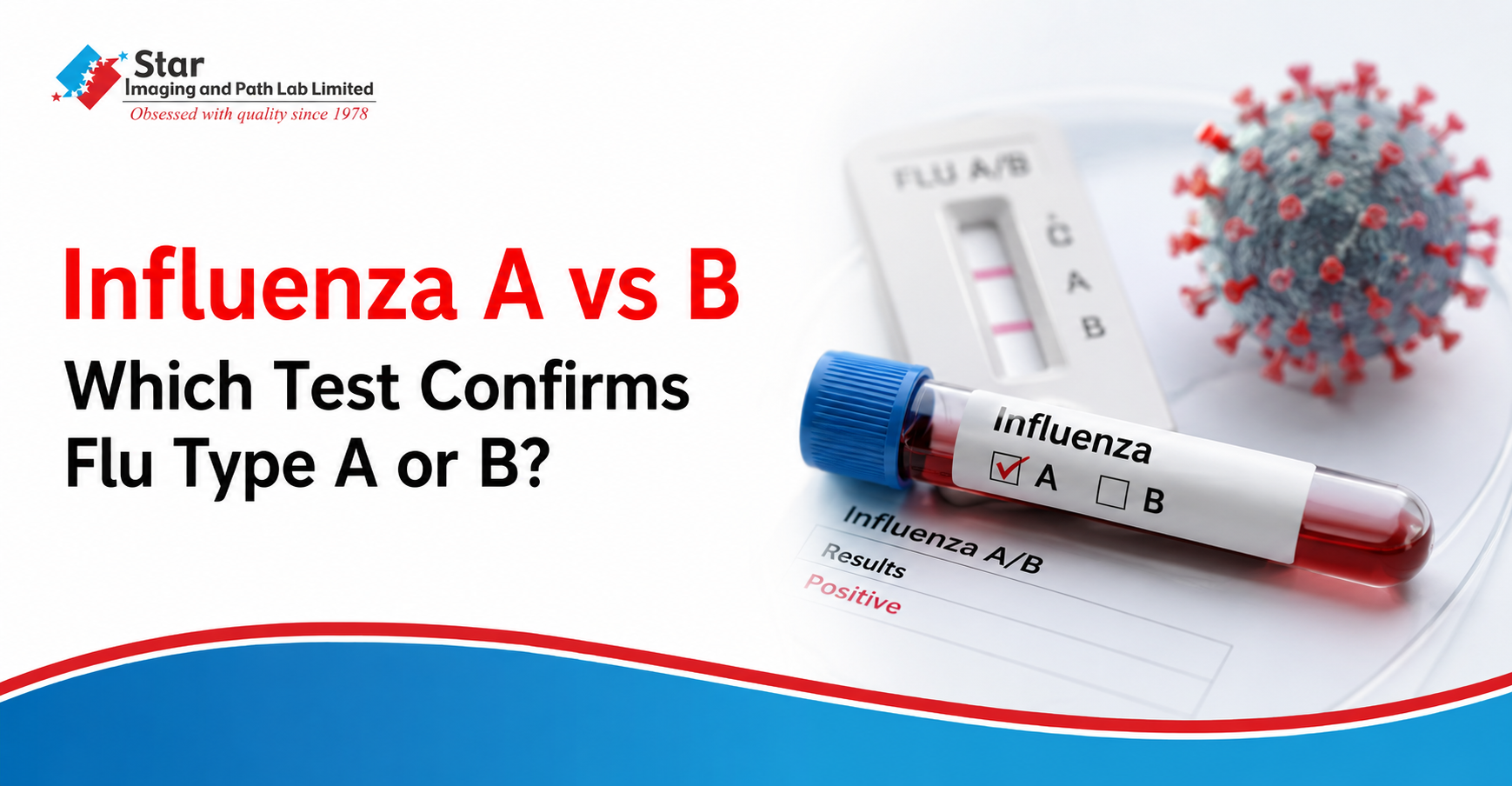
Influenza, commonly called the flu, is a contagious infection caused by influenza viruses. It mainly affects the nose, throat and airways and can cause fever, cough, sore throat, headache, body aches and tiredness.
Flu is more common during periods when influenza viruses are spreading widely in the community. It can affect people of any age, and the illness may range from mild to severe.
Among the different influenza viruses, Influenza A and Influenza B are the main types that cause seasonal flu in people. Since both can cause very similar symptoms, a person cannot reliably know which type they have just by looking at the symptoms.
At Star Imaging and Path Lab Limited, influenza RT-PCR testing is available to identify Influenza A, including H1N1 and H3N2, and Influenza B.
Influenza A vs B: What Is Actually Different?
Influenza A and Influenza B can cause very similar flu symptoms, but they are not the same type of virus. The important differences become clearer when they are compared by how they spread, how they are classified and how they affect people.
- Where they are found: Influenza A can infect humans as well as some animals, including birds and pigs. Influenza B mainly circulates among humans.
- How they are classified: Influenza A is divided into subtypes based on two surface proteins called H and N. This is why names such as H1N1 and H3N2 are used. Influenza B is classified into lineages rather than H1N1 or H3N2 subtypes.
- Which types commonly infect people: The Influenza A viruses that commonly circulate in humans include H1N1 and H3N2. Influenza B viruses include the B/Victoria lineage.
- Ability to cause pandemics: Influenza A is the only influenza type known to have caused global flu pandemics. Influenza B can cause seasonal outbreaks but has not been known to cause a pandemic.
- Symptoms: There is no reliable symptom that separates the two. Both can cause fever, cough, sore throat, headache, body aches, chills and tiredness. The severity can also vary from one person to another.
- Severity: It is not correct to say that Influenza A is always more serious than Influenza B. Either type can cause complications, particularly in young children, older adults, pregnant women and people with certain health conditions.
- How the type is confirmed: Symptoms can make a doctor suspect influenza, but they cannot reliably identify whether it is A or B. When specific identification is needed, a suitable laboratory test such as RT-PCR can distinguish the targeted influenza virus.
Why Is Influenza A Called H1N1 or H3N2?
This is where influenza names can become confusing.
Influenza A viruses are divided into subtypes according to two proteins found on their surface: haemagglutinin (H) and neuraminidase (N).
The numbers describe different forms of these proteins. For example:
- H1N1 = Influenza A with H1 and N1 proteins
- H3N2 = Influenza A with H3 and N2 proteins
So, H1N1 and H3N2 are not separate types from Influenza A. They are subtypes of Influenza A.
Influenza B is classified differently. It does not have H1N1 or H3N2 subtypes. Instead, Influenza B viruses are grouped into lineages, such as the B/Victoria lineage.
This classification is mainly useful for doctors, laboratories and public health experts who track which influenza viruses are circulating.
How Does Influenza Spread?
Influenza spreads mainly through respiratory particles released when an infected person coughs, sneezes or talks. A person can also become infected after touching contaminated surfaces and then touching their mouth, nose or eyes.
Because influenza spreads easily between people, infections can increase rapidly during flu seasons.
A person may also spread influenza around the time when symptoms begin, which makes it possible for the virus to pass to others before they realise they are infected.
What Are the Symptoms of Influenza A and B?
Influenza A and Influenza B can cause almost the same set of symptoms. The illness may start suddenly, with a person feeling noticeably unwell over a short period.
Common symptoms include:
- Fever or feeling feverish
- Chills
- Cough
- Sore throat
- Runny or blocked nose
- Headache
- Muscle or body aches
- Tiredness and weakness
Children may also have symptoms such as vomiting or diarrhoea.
How Is Flu Different From a Common Cold?
Flu and the common cold are both respiratory infections, but they are caused by different viruses.
A cold often causes symptoms such as sneezing, a runny nose and a sore throat. Influenza can cause a more sudden and intense illness, particularly with fever, chills, body aches, headache and marked tiredness.
However, there is considerable overlap between the two. A person should not assume that a particular symptom automatically means influenza.
Can Symptoms Tell Whether It Is Influenza A or B?
No. Symptoms alone cannot reliably distinguish Influenza A from Influenza B.
Both types can cause fever, cough, sore throat, headache and body aches. Even the severity of the illness does not provide a dependable answer.
For example, a high fever does not mean that the infection must be Influenza A. Similarly, severe body aches do not prove that it is Influenza B.
Other respiratory viruses can also produce similar flu-like symptoms. When knowing the exact cause matters, laboratory testing can provide more specific information.
When Can Influenza Become Serious?
Most healthy people recover from uncomplicated influenza, but the infection can sometimes lead to complications.
The risk of complications can be higher in:
- Young children
- Older adults
- Pregnant women
- People with weakened immune systems
- People with certain long-term health conditions
Complications can include pneumonia and worsening of existing health problems.
Breathing difficulty, chest pain, severe weakness, confusion, seizures or other serious symptoms require prompt medical attention.
Which Test Confirms Influenza A or B?
When a doctor needs to know whether a person has Influenza A or Influenza B, a molecular influenza test such as RT-PCR can be used.
RT-PCR stands for reverse transcription polymerase chain reaction. In simple terms, it looks for genetic material from the influenza virus in a respiratory sample.
This makes it different from a routine blood test or a general fever investigation. An influenza-specific molecular test is designed to identify the virus or specific influenza targets included in the test.
At Star Imaging and Path Lab Limited, influenza RT-PCR testing can identify Influenza A, Influenza A(H1N1), Influenza A(H3N2) and Influenza B, according to the targets included in the test.
What Sample Is Taken for an Influenza Test?
Influenza testing generally uses a respiratory sample, collected with a swab according to the laboratory's testing procedure.
The sample is then sent to the laboratory, where molecular testing is performed to look for the targeted influenza viral genetic material.
A routine blood sample is not the usual specimen used to directly identify Influenza A or B.
What Can the Influenza RT-PCR Test Identify?
The exact information depends on the targets included in the particular test.
A report may identify:
- Influenza A
- Influenza A(H1N1)
- Influenza A(H3N2)
- Influenza B
For example, if Influenza A(H1N1) is detected, it means the test has identified the targeted H1N1 influenza A virus in the respiratory sample.
The report should be read according to the test performed rather than assuming that every influenza test checks for every possible subtype.
Is Influenza A More Serious Than Influenza B?
Not necessarily. Both Influenza A and Influenza B can cause mild illness or serious complications. How severe the infection becomes depends more on the person's age, overall health and risk of complications.
Influenza A is different in one important way: it is the only influenza type known to have caused global flu pandemics. However, this does not mean every Influenza A infection is more severe than Influenza B.
So, Influenza B should not be considered a milder or less important form of flu simply because it is Type B.
How Is Influenza Treated?
Treatment depends on the person's symptoms, risk factors and how severe the illness is.
For many people with mild influenza, rest, adequate fluids and measures to control fever or discomfort may be enough while the body recovers.
When Are Antiviral Medicines Used?
Antiviral medicines are prescription medicines that can be used for influenza in appropriate patients. They may be particularly important for people who are at higher risk of complications or who have more severe illness.
Antiviral treatment generally works best when started early after symptoms begin, so people at higher risk should contact a doctor promptly rather than waiting for the illness to become severe.
The choice of medicine and whether it is needed should be decided by a healthcare professional.
Does Treatment Differ for Influenza A and B?
The treatment approach is not simply based on whether the report says A or B.
Doctors consider the person's symptoms, risk factors, severity and how long the illness has been present when deciding whether antiviral treatment or other medical care is appropriate.
When Should You Consider an Influenza Test?
Not everyone with a fever, cough or sore throat needs an influenza test.
Testing may be useful when a doctor suspects influenza and identifying the virus could help with the person's medical management or distinguish influenza from another respiratory infection.
It may be considered when:
- Flu-like illness is significant or worsening
- The person has a higher risk of complications
- The diagnosis is uncertain
- Identifying influenza would affect clinical decisions
- There is a need to distinguish Influenza A or B from other respiratory infections
The decision to test should be based on the individual's symptoms and clinical situation.
Conclusion
Influenza A and Influenza B can cause almost identical symptoms, so it is not possible to tell the difference reliably just by looking at fever, cough or body aches. When knowing the exact influenza type is important, laboratory testing can provide a clearer answer.
At Star Imaging and Path Lab Limited, influenza RT-PCR testing is available for Influenza A, including H1N1 and H3N2, and Influenza B. If flu-like symptoms are persistent or worsening, consult a doctor to understand whether influenza testing is appropriate.
Frequently Asked Questions
Question:- Is H1N1 Influenza A or B?
Answer:- H1N1 is a subtype of Influenza A. It is named according to the H and N proteins found on the surface of the virus.
Question:- Is H3N2 Influenza A or B?
Answer:- H3N2 is also an Influenza A subtype. It is different from Influenza B, which is classified into lineages rather than H1N1 or H3N2 subtypes.
Question:- Can Influenza A and B have the same symptoms?
Answer:- Yes. Both can cause fever, cough, sore throat, headache, body aches, chills and tiredness. The symptoms cannot reliably tell which type is responsible.
Question:- Which test confirms Influenza A or B?
Answer:- An influenza RT-PCR test can detect influenza viral genetic material in a respiratory sample and identify the targeted Influenza A or Influenza B virus.
Question:- Is Influenza B less serious than Influenza A?
Answer:- Not always. Both types can cause serious illness and complications. Influenza A is known to have caused pandemics, but that does not mean every Influenza A infection is more severe than Influenza B.
Question:- Can a blood test detect Influenza A or B?
Answer:- Influenza-specific testing generally uses a respiratory sample, rather than a routine blood sample, to look for influenza viral genetic material.
Question:- Can flu be diagnosed from fever alone?
Answer:- No. Fever can occur with influenza as well as many other infections. Fever by itself cannot confirm influenza or tell whether it is Type A or Type B.
Question:- What does “Influenza A detected” mean on a report?
Answer:- It means the test detected the targeted Influenza A viral genetic material in the respiratory sample. If subtype testing is included, the report may provide additional information such as H1N1 or H3N2.


1.png)
.png)
.jpg)
.png)

.jpg)

Comments List