
FNAC Test: What It Is, How It Is Done, Uses, Preparation and Results
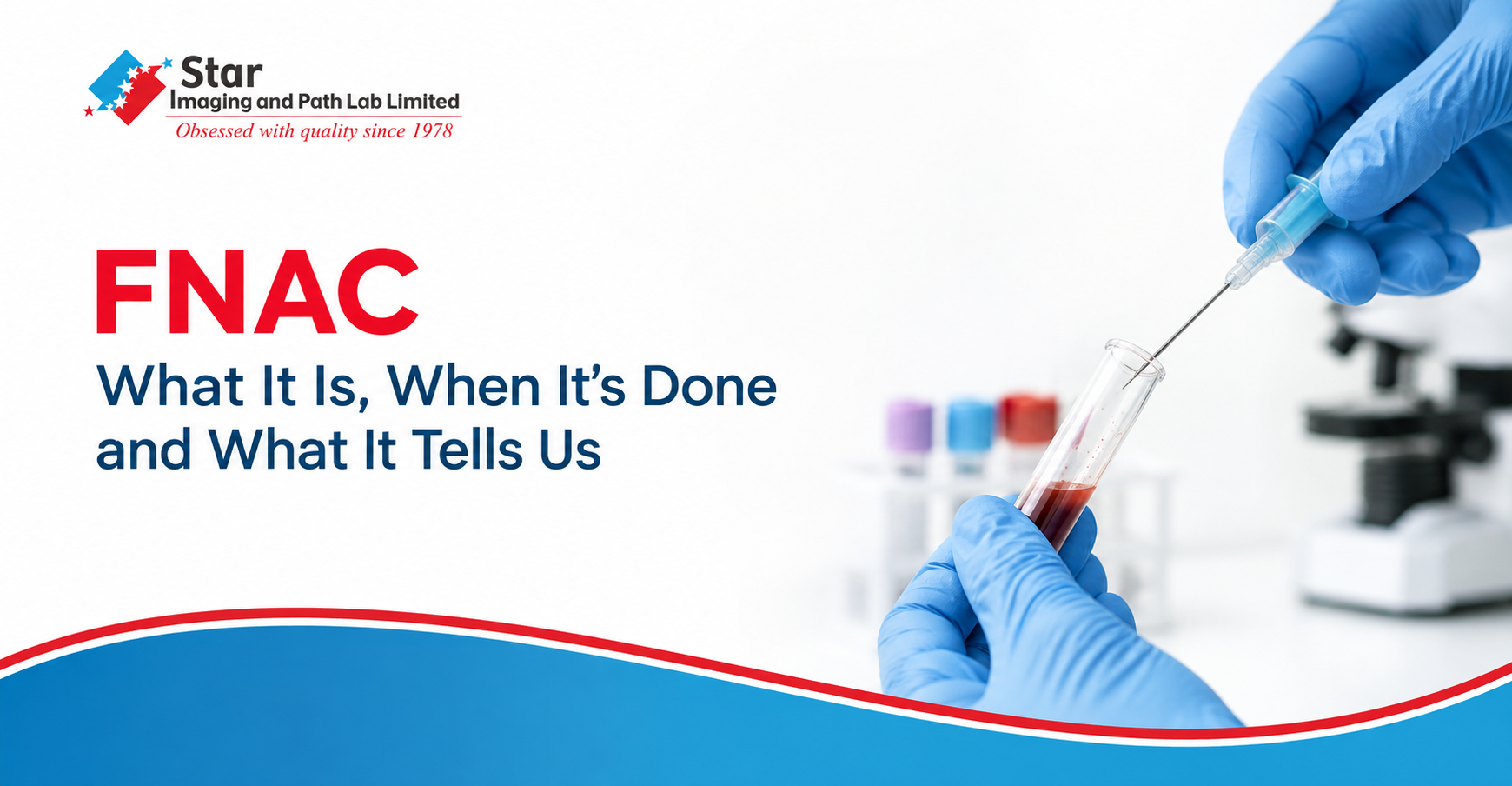
Fine Needle Aspiration Cytology (FNAC) is a minimally invasive diagnostic procedure used to examine lumps, masses, and enlarged lymph nodes in various parts of the body. At Star Imaging and Path Lab, experienced radiologists and pathologists perform FNAC. This helps doctors distinguish between non-cancerous (benign) and cancerous (malignant) lumps, plan further investigations, and determine the appropriate treatment.
What Is an FNAC Test?
FNAC stands for Fine Needle Aspiration Cytology. It is also referred to as FNA (Fine Needle Aspiration) or FNAB (Fine Needle Aspiration Biopsy) when the emphasis is on obtaining a biopsy sample.
In an FNAC test:
-
A fine gauge needle (much thinner than those used for routine blood tests) is inserted into a lump, mass, or swollen area.
-
A small amount of cells or fluid is extracted from the wound or lump.
-
The sample is spread onto a glass slide, stained, and examined under a microscope by a pathologist trained in diagnostic and cancer cytopathology.
The primary purpose of FNAC is to determine whether a lesion is:
-
Benign (non-cancerous)
-
Malignant (cancerous)
-
Suspicious or indeterminate (requires further evaluation)
-
Inadequate (insufficient cells for a definitive diagnosis)
FNAC is commonly used for:
-
Thyroid nodules
-
Breast lumps
-
Enlarged lymph nodes in the neck, axilla, or groin
-
Salivary gland swellings
-
Selected liver masses, pancreatic cysts, and other deep lesions, usually under ultrasound or CT guidance
Why is FNAC performed?
When a palpable lump or an abnormality on imaging (such as a breast cancer lump, thyroid nodule, or a mass in the neck, liver, or pancreas) is detected in a patient, the most critical question is whether the lump is cancerous or a harmless (benign) condition.
FNAC helps in:
-
Differentiating cystic lesions (fluid-filled) from solid tumors
-
Detecting malignant cells or tumor cells in samples from the breast, thyroid, lymph nodes, pancreas, liver, and other sites
-
Guiding decisions about further investigations such as core needle biopsy, bone marrow biopsy, endoscopic procedures, or surgical intervention
In many clinical procedures, FNAC is used as an initial method of tissue sampling before proceeding to more invasive options, such as surgical excisional biopsy, mastectomy, or major oncological surgery.
Clinical Uses of FNAC at Star Imaging and Path Lab
FNAC is used across several specialties, including surgical oncology, medical oncology, endocrinology, gastroenterology, and radiology. Our pathologists and radiologists typically examine FNAC samples in these clinical situations:
1. Breast lump and breast examination
FNAC is often used to examine these:
-
A recently detected lump in the right or left breast
-
Abnormalities visible on breast ultrasound or other imaging
-
Suspicion of a neoplasm (tumor) or other lesions in the breast
Based on FNAC findings, clinicians decide between:
-
Routine check-ups for clearly non-cancerous lesions
-
Further assessment through extra imaging or biopsy when required
-
Other breast procedures as advised by your treating doctor
Thus, FNAC is a crucial part of breast cancer diagnostic tests and breast assessment protocols.
2. Thyroid Nodules
Thyroid nodules are common, and most of them are benign or harmless. However, some nodules can be a sign of thyroid cancer. FNAC (Fine Needle Aspiration Cytology) is an essential test used to weigh thyroid nodules and determine whether further testing is required. The results are typically reported using a standard system, such as the Bethesda classification.
-
Nodules with suspicious ultrasound features
-
Rapidly growing nodules
-
Nodules associated with compressive symptoms or high-risk clinical history
FNAC helps classify nodules as benign (harmless), suspicious, or malignant (cancerous), guiding decisions regarding monitoring, repeat FNAC, or thyroid surgery.
3. Neck Lumps and Lymph Nodes
A lump or swelling in the neck should not be ignored, especially if it feels hard, persists for some time, or increases in size. An FNAC of the cervical lymph nodes can help determine the cause of the swelling and may also reveal:
-
Reactive or inflammation-related changes
-
Granulomatous diseases (e.g., TB)
-
Accumulation of metastatic cancer cells from primary tumors in the breast, lung, head and neck region, or other sites
In patients suspected of having head and neck cancer, lung cancer, or unexplained lymph node swelling (lymphadenopathy), FNAC is often the first tissue-based test performed before proceeding to further imaging, endoscopy, or advanced diagnostic tests.
4. Other Deep Lesions (Selected Cases)
Some lumps or lesions are located deep inside the body and may be difficult to reach directly. In such cases, imaging can help guide the needle during FNAC and allow the sample to be taken from the required area.
-
Selected liver lumps
-
Pancreatic cysts or lumps in specific situations
-
Other lesions or lumps identifiable via imaging, as advised by your doctor
Techniques may include:
-
Ultrasound guided biopsy for accessible lesions
-
Other image-guided approaches in coordination with your treating hospital or specialist
These procedures support:
-
It helps in understanding the nature of the lump or swelling at an early stage.
-
It helps your doctor decide whether further tests, a specialist consultation, or treatment are required.
How Is the FNAC Test Performed at Star Imaging and Path Lab?
The FNAC procedure at Star Imaging and Path Lab is simple and is usually completed in a short time.
Before the Procedure
-
Your doctor will first review your medical history and examine the lump or swelling. Depending on the area being examined, you may also be advised to undergo imaging tests such as a breast ultrasound or another scan before the FNAC procedure.
-
You should also inform your doctor about all medications you are taking, especially blood thinners, and mention if you have ever had any bleeding related issues.
-
For most superficial FNAC procedures, fasting is generally not required. However, if the FNAC is being performed for a deep seated lump or lesion, you might be asked to fast beforehand, depending on your doctor’s advice and the specific requirements of the procedure.
During the Procedure
-
You will be made comfortable in a sitting or lying position, depending on the area being examined, such as the breast, thyroid or neck.
-
The skin over the area is cleaned with an antiseptic solution.
-
A very fine needle attached to a syringe is gently inserted into the lump or lesion.
-
The doctor carefully moves the needle to collect a small sample of cells or fluid. This process is known as Fine Needle Aspiration.
-
Once the sample is collected, the needle is removed and gentle pressure is applied to the area to reduce the chance of minor bleeding or bruising.
For selected deep lesions, the procedure may be performed with:
-
Ultrasound guidance to help place the needle accurately
Samples may be collected multiple times to ensure sufficient cellularity for examination.
After the Procedure
-
Generally, you can resume your normal activities on the same day.
-
Mild pain, tenderness, or slight bruising at the injection site (such as under the breast, on the neck, or on the abdominal wall) is common and resolves within 24–48 hours.
-
Specific advice may be provided depending on the sampling site and the surrounding area.
Most patients describe the sensation as a brief pinch and pressure; FNAC is among the least invasive biopsy options compared with open biopsy or surgical procedures.
Preparation for FNAC Test
Preparation for FNAC at Star Imaging and Path Lab is minimal but important:
-
Inform your doctor about all medications, particularly anticoagulants and antiplatelet drugs.
-
Mention any history of bleeding disorders, allergies, or previous adverse reactions to local anesthetics.
-
Carry prior imaging reports (breast ultrasound, other scans) and previous biopsy results if available.
-
Wear clothing that allows easy access to the area being sampled (e.g., neck, breast, abdomen).
If you are anxious or have had difficult experiences during previous procedures, let the team know so they can adjust their approach and the way they explain things accordingly.
Risks and Complications
FNAC is a safe procedure with a low complication rate. Possible risks include:
-
Mild pain or tenderness at the puncture site
-
Small bruise or local discoloration
-
Rarely, minor bleeding, infection, or vasovagal symptoms
Serious complications are uncommon with FNAC. Compared with more invasive procedures such as surgical biopsies or major surgery, FNAC usually involves fewer risks.
Your doctor will let you know if any specific precautions are needed after the procedure. These may depend on the area from which the sample was taken, such as the breast, neck or any other part of the body.
Interpretation of FNAC Test Results
FNAC does not produce a numeric “normal range” like routine blood tests. Instead, the pathologist provides a descriptive report based on microscopic examination of the aspirated cells.
Common categories include:
-
Benign: No evidence of malignancy; examples include cysts, fibroadenoma of the breast, colloid goiter in the thyroid, or reactive lymph nodes.
-
Malignant: Features diagnostic of cancer, such as adenocarcinoma of the breast, metastatic carcinoma in lymph nodes, or primary thyroid malignancy.
-
Suspicious / Indeterminate: Atypical cells that are not definitively benign or malignant; may require repeat FNAC or further evaluation.
-
Inadequate / Unsatisfactory: Insufficient cellularity for diagnosis; repeat sampling or alternative biopsy may be recommended.
What Does “FNAC Negative” Mean?
“FNAC negative” generally indicates:
-
No malignant cells were found in the sample.
-
Based on the cytological characteristics, the lesion is likely benign.
This does not completely rule out the possibility of the disease; therefore, clinical correlation and follow-up imaging may be recommended.
What Does “FNAC Positive” Mean?
“FNAC positive” typically means:
-
Clear signs of malignant cells or cancer are present.
-
The report may specify the type of malignancy, such as ductal adenocarcinoma of the breast or metastatic carcinoma.
Following a positive FNAC, further tests are usually conducted to determine the stage of the disease, and an appropriate treatment plan is devised in consultation with medical oncology, clinical oncology, and surgical teams; this treatment may include surgery, radiation, systemic therapy, or other modalities.
FNAC at Star Imaging and Path Lab
At Star Imaging and Path Lab, FNAC is more than just a test. It helps doctors understand what a lump or swelling could be and provides important information for deciding the next step in treatment.
Our approach includes:
-
Experienced Operators: Clinicians skilled in performing FNAC (via manual palpation or image-guided techniques) on the breast, thyroid, lymph nodes, and other body sites.
-
Advanced Cytopathology: Pathologists trained in diagnostic cytopathology, capable of examining and interpreting complex cases such as breast lesions, thyroid nodules, metastatic neck masses, and other samples.
-
Integrated Reporting: Reports providing clear clinical information, tailored to the needs of treating physicians across oncology, surgery, endocrinology, and other specialties.
-
Patient-Centric Care: Prioritizing patient comfort, providing clear information about the procedure, and offering appropriate advice on post-procedure care.
If your doctor has recommended an FNAC test, you can get it done at Star Imaging & Path Lab Limited. Our team will guide you through the procedure and let you know if any preparation is needed before the test.
FAQs About FNAC
Q: What does FNAC positive mean?
A: A positive FNAC result means that abnormal cells or findings were identified in the sample. The exact interpretation depends on the type and location of the lesion and should be discussed with your doctor.
Q: What diseases can FNAC test detect?
A: FNAC can help evaluate lumps and swellings in areas such as the thyroid, breast, lymph nodes and salivary glands. It may help identify infections, benign conditions and cancerous or suspicious cells.
Q: What is the FNAC test cost?
A: The cost of FNAC depends on the location being examined, the procedure and any additional tests required. Contact Star Imaging & Path Lab for the current FNAC test cost.
Q: Is an FNAC biopsy painful?
A: FNAC involves using a fine needle to collect cells from a lump or swelling. You may feel a brief pinching sensation or mild discomfort during the procedure.
Q: Is FNAC better than a biopsy?
A: FNAC and biopsy are different diagnostic procedures. FNAC examines cells, while a biopsy examines a tissue sample. Your doctor will recommend the appropriate test based on your condition.
Q: How many days does it take for FNAC results?
A: FNAC results are usually available within a few days. The turnaround time may vary depending on the sample and whether additional laboratory tests are required.
Q: Is an FNAC test risky?
A: FNAC is a minimally invasive procedure and is generally considered safe. Mild pain, tenderness or minor bleeding may occur at the needle insertion site.
Q: Why would a doctor order FNAC?
A: A doctor may recommend FNAC to examine an unexplained lump, swelling or nodule and determine the nature of the cells present.
Q: What if the FNAC test is negative?
A: A negative FNAC result means that abnormal or malignant cells were not identified in the sample. Your doctor may recommend further testing if the clinical or imaging findings still require investigation.


.jpg)

.jpg)
.png)



Comments List