
Neck Swelling in a 16-Year-Old: A Case of Pleomorphic Adenoma
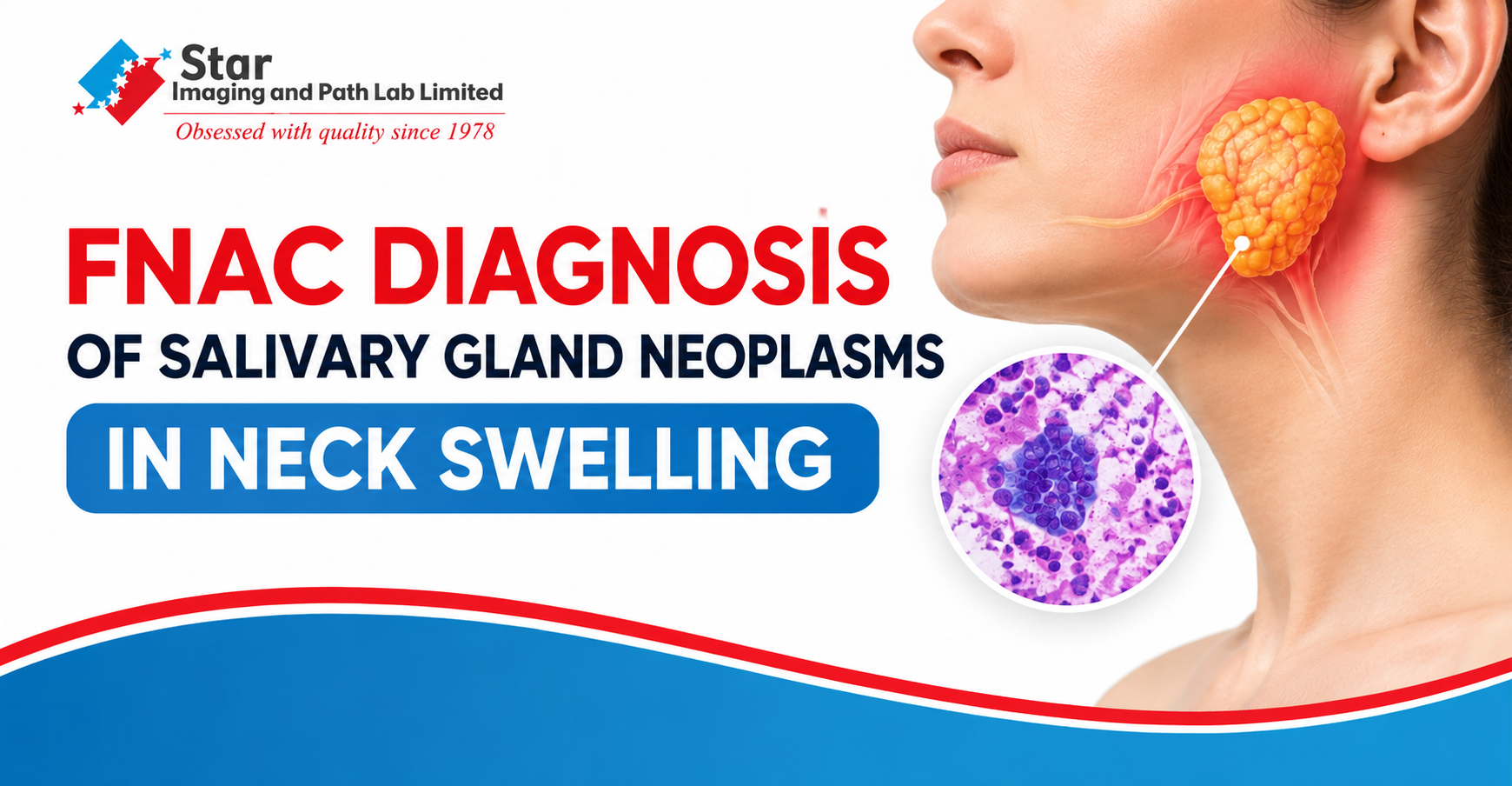
A swelling in the neck can seem like a straightforward clinical finding, particularly when it is not accompanied by pain, fever, difficulty swallowing or any other obvious complaint. But sometimes, the absence of symptoms is precisely what makes a case diagnostically interesting. A recent case evaluated at Star Imaging and Path Lab Limited involved a 16 year old girl who presented with a swelling on the right side of the neck, with no other associated complaints.
At first glance, there was little in the clinical presentation to suggest the nature of the lesion. The answer came from examining the cells.
Fine Needle Aspiration Cytology, or FNAC, was performed to evaluate the swelling. The cytological findings favoured a benign salivary gland neoplasm, favouring pleomorphic adenoma. The lesion was also categorised as a salivary gland neoplasm of uncertain malignant potential, reflecting the importance of maintaining diagnostic caution when cytological features do not allow an unequivocal benign or malignant classification.
That distinction matters. Salivary gland lesions can have overlapping cytological appearances, and FNAC is often used as an important preoperative investigation to characterise these lesions. Pleomorphic adenoma is the most common benign salivary gland tumour and can occur in younger patients, although salivary gland tumours themselves are relatively uncommon in the paediatric and adolescent population.
What the Cells Revealed
Pleomorphic adenoma is known for its varied microscopic appearance, with epithelial and myoepithelial elements occurring alongside a characteristic stromal component. This diversity is also why cytological assessment can sometimes present a diagnostic challenge. Depending on the cellular composition sampled, some lesions may not fit neatly into a single category on FNAC.
In this case, the cytological picture favoured pleomorphic adenoma, but the reporting also retained an element of diagnostic caution. Rather than forcing a definitive label where the cytology did not completely support one, the findings were placed within the category of salivary gland neoplasm of uncertain malignant potential.
For a pathologist, this is an important distinction. A cytology report is not simply a description of what is seen under the microscope. It is a carefully considered assessment that has to communicate what the available cellular material supports, where uncertainty remains, and what that means in the context of further clinical management.
Why FNAC Matters in Such Cases
FNAC offers a minimally invasive way of obtaining cellular material from a palpable lesion and can provide valuable information before definitive treatment is planned. Studies have demonstrated its utility in evaluating salivary gland lesions, while also highlighting the diagnostic overlap that can occur between pleomorphic adenoma and certain other salivary gland tumours.
The significance of this case lies not merely in the diagnosis of a pleomorphic adenoma in a young patient. It lies in the diagnostic process itself: a seemingly uncomplicated neck swelling required cellular evaluation to reveal that it was related to a salivary gland neoplasm, with cytology favouring a benign diagnosis while appropriately retaining diagnostic caution.
For Dr. Abhilasha Maru, Consultant Pathologist at Star Imaging and Path Lab Limited, the case reinforces an important principle of diagnostic pathology:
“In cytopathology, the most responsible diagnosis is not always the most definitive sounding one. When the cells support a benign possibility but leave a diagnostic boundary unresolved, acknowledging that uncertainty is itself a mark of precision. The role of the pathologist is to interpret what the specimen truly shows, without allowing assumptions about age or presentation to influence the diagnosis.”

The case is a reminder that even an isolated neck swelling in an adolescent can present a diagnostic question that goes considerably deeper than its clinical appearance. Sometimes, the most important information is not visible from the outside. It is contained within the cells.
FAQs
Question: Can pleomorphic adenoma occur in teenagers?
Answer: Yes. Although salivary gland tumours are uncommon in children and adolescents, pleomorphic adenoma is among the benign salivary gland neoplasms reported in this age group.
Question: What does “salivary gland neoplasm of uncertain malignant potential” mean?
Answer: It indicates that the cytological findings show a neoplastic salivary gland lesion, but the available cellular material does not allow the pathologist to confidently classify it as definitively benign or malignant. It is therefore a category of diagnostic caution rather than a direct diagnosis of cancer.
Question: Why is FNAC performed for a salivary gland or neck swelling?
Answer: FNAC allows cells from the lesion to be examined with a minimally invasive procedure. The findings can help distinguish neoplastic lesions from inflammatory or other processes and can assist clinicians in planning further management.
Question: Why can pleomorphic adenoma sometimes be difficult to diagnose on FNAC?
Answer: Pleomorphic adenoma can contain different cellular and stromal components. If the aspirated sample does not capture representative areas of the lesion, its cytological appearance may overlap with other salivary gland tumours.
Question: Does a neck swelling without pain mean that it is harmless?
Answer: Not necessarily. Pain and other symptoms alone cannot establish whether a swelling is benign, inflammatory or neoplastic. The nature of a lesion requires appropriate clinical and, where indicated, diagnostic evaluation.


.jpg)
.png)
.png)
.jpg)

.png)

.jpg)


Comments List