
Alzheimer’s Disease Diagnosis: Why Both Imaging and Pathology Are Essential
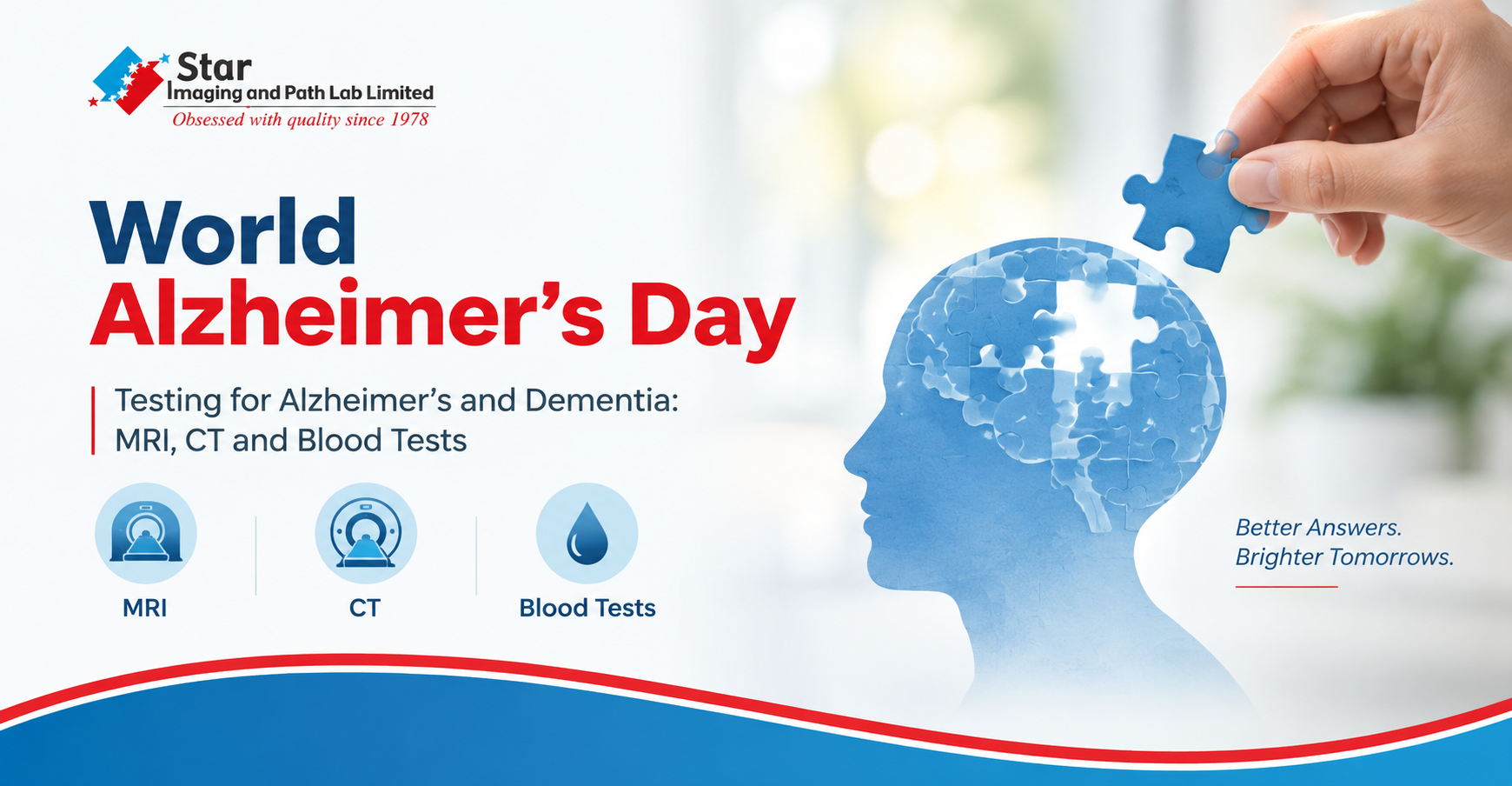
Memory changes can be scary. But not every forgetful moment means Alzheimer’s disease.
Sometimes, stress, poor sleep, or vitamin deficiency can cause memory problems. Sometimes, the brain changes in a way that needs medical attention.
That is why testing for Alzheimer’s and dementia is done step by step. Doctors first speak with the patient and their family. They check memory, thinking abilities, and daily activities, and then determine which tests are required.
At Star Imaging & Path Lab Limited, we do not rely on just a single test. We utilize clinical assessments, brain imaging (such as MRI or CT scans for Alzheimer's), and laboratory tests. In some cases, specialized blood tests (biomarkers) for Alzheimer's are also used.
On World Alzheimer’s Day, the global message is clear: “The Earlier You Know, The More You Can Do.” Early dementia diagnosis gives families more time, more options, and more control.
How Is Alzheimer’s Disease Diagnosed?
Alzheimer’s disease diagnosis does not start with a scan or a report. It starts with the person.
Doctors look at:
-
Medical history and current medicines
-
How memory, thinking and behaviour have changed
-
How daily tasks (like cooking, managing money, taking medicines) are being handled
Based on this, they plan the right tests. These may include:
-
Cognitive tests (memory and thinking checks)
-
Blood and other lab investigations
-
Brain imaging: MRI, sometimes CT, and in select cases PET
-
In specialist settings, blood test or CSF biomarker tests
Its aim is not only to detect Alzheimer's but also to identify other, treatable causes of memory loss.
What Tests Are Done for Memory Loss and Dementia?
When someone has ongoing memory issues, doctors may suggest a mix of tests.
1. Cognitive and Neurological Assessment
These are simple cognitive tests done by a doctor or psychologist. They check:
-
Memory, attention, language
-
Problem-solving and daily functioning
This helps decide if the problem looks like normal age-related change, early Alzheimer’s symptoms, or another condition.
2. Blood Tests and Lab Investigations
Routine blood tests look for conditions that can cause or worsen cognitive problems, such as:
-
Thyroid problems
-
Vitamin B12 or folate deficiency
-
Infections, anemia, liver or kidney issues
In some centres, a blood test for Alzheimer’s (biomarker test) may also be advised. This is different from routine tests and needs expert interpretation.
3. Brain Imaging: MRI and CT
Imaging does not diagnose Alzheimer’s by itself. But it gives important clues.
-
MRI for Alzheimer’s shows:
-
Patterns of brain shrinkage (atrophy) in memory areas
-
Vascular changes (small strokes, white matter changes)
-
Other structural problems like tumour, bleed, or fluid build-up
-
-
CT scan may be used when MRI is not suitable. It can show:
-
Stroke, bleeding, masses, or fluid-related changes
-
Both help rule out other causes of dementia and Alzheimer’s symptoms.
4. Biomarker Tests (Specialist Settings)
In selected cases, doctors may advise:
-
Blood test for Alzheimer’s (plasma/serum biomarkers)
-
CSF (spinal fluid) biomarker tests
These tests give information about Alzheimer’s-related changes in the brain. They are not standalone proof. They are always read with the clinical picture and imaging.
Stages of Alzheimer’s Disease (Simple Overview)
Learning about the stages of Alzheimer's helps families prepare for the changes ahead.
-
Preclinical stage
-
Brain changes have started, but there are no clear symptoms yet.
-
This stage is typically observed in research or in the assessment of specific risks.
-
-
Mild (early) stage
-
Early signs of Alzheimer’s may appear:
-
Forgetting recent conversations or events
-
Repeating questions
-
Trouble finding words
-
-
Person can still manage most daily tasks with some support.
-
-
Moderate (middle) stage
-
Memory loss diseases like Alzheimer’s become more obvious.
-
Problems with:
-
Managing money, medicines, cooking
-
Recognising familiar people or places
-
-
Behaviour and mood changes may increase.
-
-
Severe (late) stage
-
Person needs help for most daily activities.
-
Communication becomes very limited.
-
Physical problems (like walking, swallowing) can appear.
-
Not everyone goes through these stages of Alzheimer's in the same way. Early diagnosis and support can improve the quality of life at every stage.
Early Signs of Alzheimer’s You Should Not Ignore
Many people ignore early Alzheimer’s symptoms as “normal ageing”. But some signs need attention:
-
Forgetting recent events again and again
-
Getting lost in familiar places
-
Trouble handling bills, medicines, or kitchen work
-
Repeating the same questions or stories
-
Noticeable changes in mood, behaviour or judgment
These can be early signs of dementia and Alzheimer’s. They do not always mean Alzheimer’s, but they do mean a proper check-up is needed.
If you notice such symptoms of memory loss, consult a doctor. Early detection of dementia gives families more options for planning and care. This is also the aim of World Alzheimer's Day: taking early action instead of waiting.
Why Radiology and Pathology Must Work Together
Different questions are asked during the assessment for dementia and Alzheimer's:
-
Imaging (radiology) answers the question: "What does the structure of the brain look like?"
-
Lab test (pathology) results: "Are there any medical or biological reasons involved?"
At Star Imaging and Path Lab Limited:
-
We offer integrated Radiology and Pathology services under one roof.
-
Our Radiology is NABH-accredited; our Pathology is NABL-accredited.
-
We have been serving Delhi-NCR since 1978 with a focus on quality and consistency.
In the case of complex diseases like Alzheimer's, no single test provides a complete picture. Combining various tests helps doctors better understand the condition and diagnose it based on accurate information.
When Should Someone Get Tested for Alzheimer’s or Dementia?
There is no specific age for dementia or Alzheimer's testing. However, you should consider getting tested if the following conditions apply:
-
Memory issues are persistent or getting worse
-
Daily tasks are becoming harder to manage
-
Family or caregivers notice clear, repeated changes in thinking or behaviour
At Star Imaging and Path Lab Limited, we see diagnostics as a connected process rather than a collection of individual tests.
Frequently Asked Questions (FAQs)
What is the main cause of Alzheimer's?
Alzheimer’s disease is mostly connected to changes, in the brain. These changes include the buildup of amyloid plaques and tau proteins. The biggest known risk factor is age. Genetics, family history and other health conditions can also make the risk higher.
What is the final stage of Alzheimer's?
The final stage of Alzheimer’s is when memory loss is very strong and the person can no longer talk, walk, eat or do tasks alone. In this stage the person usually needs care all day. Constant help.
Has anyone ever recovered from Alzheimer's?
There is no proven cure that can completely undo Alzheimer’s disease. Some medicines can help relieve symptoms or slow how fast the disease goes on in some people. They do not make the brain become the way it was before.
Can people live normal lives with Alzheimer's?
People who have early‑stage Alzheimer’s can still do many of their activities if they get some help and make changes. As the disease goes on problems with memory and thinking. The need for help with daily tasks becomes larger.
At what age do Alzheimer's symptoms start?
People who have early‑stage Alzheimer’s can still do many of their activities if they get some help and make changes. As the disease goes on problems with memory and thinking. The need for help with daily tasks becomes larger.
What is the difference between dementia and Alzheimer's?
Dementia is a word for problem with memory, thinking and everyday life while Alzheimer’s disease is a special brain problem that can cause dementia. Alzheimer’s is the common reason, for dementia but not every dementia is caused by Alzheimer’s disease.


.png)
.jpg)

.jpg)

Comments List