
WORLD HEART DAY 2026 When the Heart Needs More Than a Beat
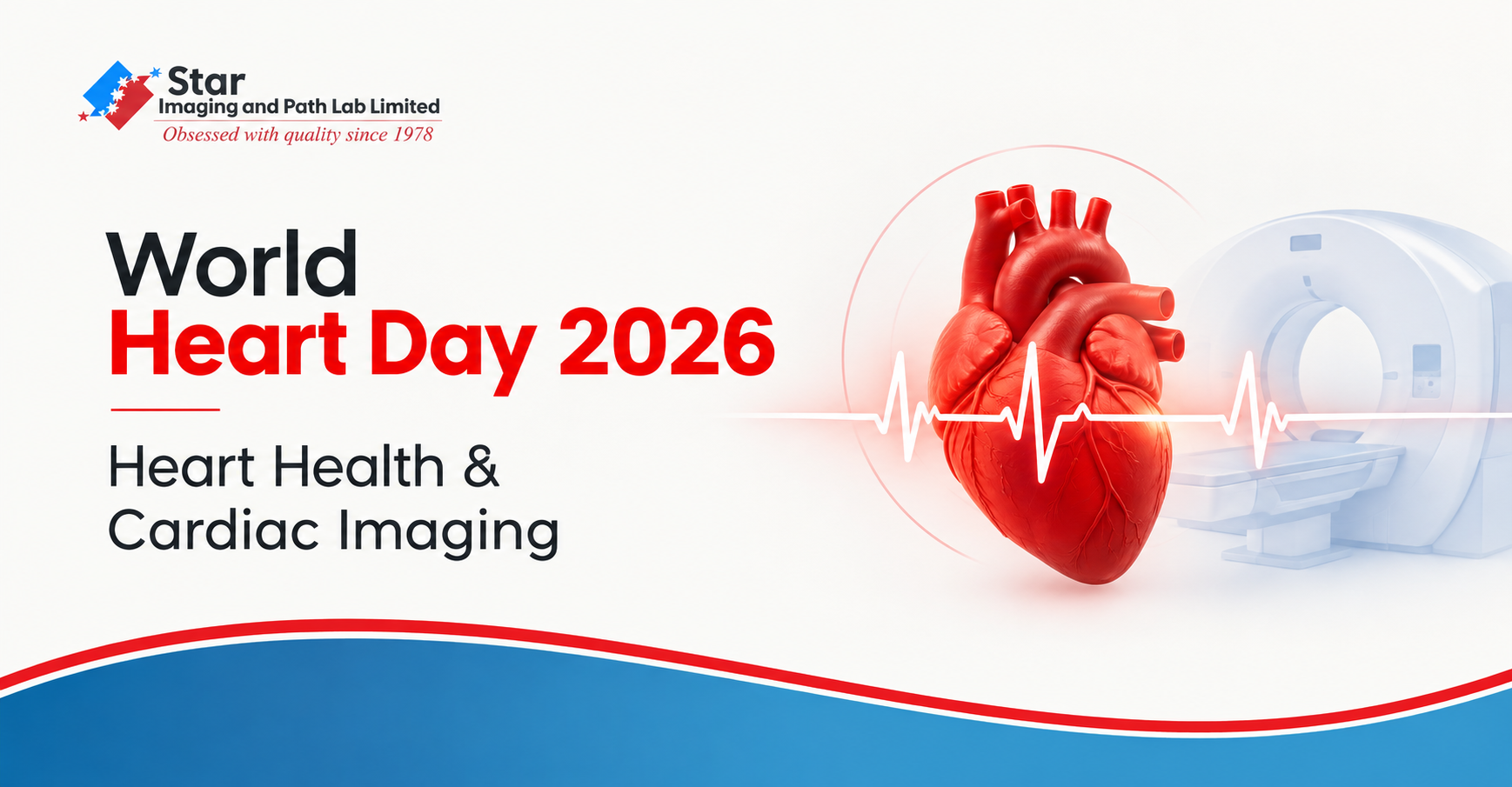
The heart works quietly, continuously and without asking for our attention. It beats while we work, sleep, travel, exercise and go about the ordinary business of life. Yet when something feels different, a little more breathlessness than usual, discomfort in the chest, unusual fatigue or an unexplained change in how we feel, the question is often simple but important. What is the heart trying to tell us?
World Heart Day, observed every year on 29 September, brings that question into focus. The 2026 World Heart Day campaign by the World Heart Federation carries the message “Heart Disease Can Hide in Plain Sight. Don’t Miss a Beat”, encouraging people to recognise signs and symptoms that can otherwise go unnoticed.
But recognising a concern is only one part of the process. The next part is knowing what information can help a doctor understand it.
At Star Imaging and Path Lab Limited, one of Delhi NCR's established diagnostic centres, this approach brings together advanced imaging, specialised reporting and laboratory expertise across a comprehensive diagnostic ecosystem. When the subject is the heart, the combination of technology and specialist expertise becomes particularly important.
Seeing the Heart in Motion
The heart is one of the most challenging organs to image. It never stays still. It beats continuously, and the coronary arteries that supply blood to the heart are small structures moving with every heartbeat.
This is where advances in CT imaging have made a meaningful difference.
Modern cardiac CT systems are designed to acquire detailed images at remarkable speed. At Star Imaging and Path Lab Limited, advanced CT imaging is supported by technology capable of approximately 0.27 second acquisition and up to 1184 reconstructed images per second. The system also supports single heartbeat cardiac imaging, helping capture detailed information while the heart is in motion.
For someone sitting outside the scanning room, these numbers may sound technical. Their real significance is much simpler. The faster and more precisely an image can be acquired, the more useful information there may be for the radiologist interpreting the examination.
Cardiac imaging is no longer simply about taking an image of the heart. It is about capturing a moving organ with enough detail to answer a specific clinical question.
CT Coronary Angiography and the Coronary Arteries
One of the important advances in cardiac imaging is CT Coronary Angiography, also known as Coronary CT Angiography or CCTA.
The coronary arteries are the blood vessels that supply oxygen rich blood to the heart muscle. With CCTA, CT imaging and intravenous contrast are used to create detailed images of these vessels. The resulting images can be reconstructed into different views, including three dimensional representations, allowing physicians to assess the coronary arteries for plaque, narrowing and other abnormalities.
At Star Imaging and Path Lab Limited, CT Coronary Angiography forms part of an advanced cardiac imaging approach, supported by high speed CT acquisition and specialist radiological interpretation. The combination is designed to provide detailed anatomical information when the coronary arteries need closer evaluation.
This can be particularly relevant when a patient has symptoms such as chest discomfort or when previous cardiac investigations have not provided enough information. CCTA does not replace every other cardiac test, nor is it appropriate for every patient. The choice of investigation depends on the individual clinical situation and the question the treating doctor needs answered.
That distinction matters.
Good cardiac diagnostics is not about doing the most advanced test simply because it is available. It is about choosing the right investigation for the right clinical question and then interpreting the information carefully.
From Better Images to Better Information
Technology is only one part of cardiac diagnosis.
A patient may undergo an ECG, blood tests, an echocardiogram, CT imaging or another investigation depending on the symptoms and clinical assessment. Each examination provides a different piece of information about the heart.
Advanced CT imaging can add another important layer by allowing detailed assessment of cardiac anatomy and the coronary arteries.
For the radiologist, this means having high quality images that can be examined from multiple perspectives. For the treating physician, it means having more information to consider alongside the patient's symptoms, medical history and other test results.
This is where the advancement in diagnostic technology becomes meaningful. Not because a machine can replace clinical judgement, but because better information can support a more informed interpretation.
This is also where the experience of a diagnostic centre matters. At Star Imaging and Path Lab Limited, advanced imaging is supported by specialist radiologists and an established diagnostic infrastructure, with NABH accredited radiology services and NABL accredited laboratory services. The objective is not simply to generate images or numbers, but to bring together quality acquisition, specialist interpretation and relevant clinical information.
Four Specialists. One Conversation About Heart Health.
Heart health does not belong to one specialty.
It brings together different perspectives, from cardiovascular medicine and radiology to pathology and laboratory investigations. A cardiologist may look at the clinical picture and symptoms. A radiologist may assess what advanced imaging reveals about anatomy. A pathologist can provide valuable information through laboratory investigations and biomarkers.
That multidisciplinary perspective is reflected in the work at Star Imaging and Path Lab Limited, where Radiology, Pathology and Cardio Diagnostics form part of a wider diagnostic ecosystem serving patients across Delhi NCR.
For World Heart Day, our specialists share their perspectives on what people should know about their heart health and the signs that deserve attention.
Watch the conversation with our four specialists.
[Click Here to watch]
The most important message may be the simplest one.
Do not ignore a change simply because it seems small. Do not assume that every symptom has the same explanation. And do not assume that one test can answer every question.
Modern cardiac diagnostics gives doctors more ways to look at the heart. The real value lies in knowing when to use them, how to interpret what they show and how that information fits into the person sitting in front of them.
For a diagnostic centre such as Star Imaging and Path Lab Limited, this means looking beyond individual investigations and bringing technology, expertise and quality systems together under one diagnostic framework.
This World Heart Day, perhaps the best way to think about heart health is not simply as something we remember once a year.
It is something worth paying attention to every time the heart gives us a reason to listen.
World Heart Day 2026
Heart disease can hide in plain sight. Don’t miss a beat.
Star Imaging and Path Lab Limited
Advanced Imaging | Pathology | Cardio Diagnostics | Delhi NCR
Frequently Asked Questions
Question: Why is World Heart Day relevant to cardiac diagnostics?
Answer: World Heart Day draws attention to cardiovascular health and the importance of recognising factors and symptoms associated with heart disease. Diagnostics play an important role by giving doctors clinical information that can help evaluate a person’s heart health when an investigation is considered appropriate.
Question: What heart symptoms should not be casually ignored?
Answer: Chest discomfort, unusual breathlessness, unexplained fatigue, dizziness or a noticeable change in exercise tolerance can have several possible causes. World Heart Day is a useful reminder to pay attention to persistent or unusual changes and discuss them with a doctor rather than assuming they will simply pass.
Question: How has technology changed the way doctors can look at the heart?
Answer: Advances in cardiac imaging have made it possible to capture detailed information about the heart and coronary arteries with greater speed and sophisticated image reconstruction. Modern CT technology can capture a moving heart rapidly, giving radiologists detailed anatomical information for interpretation.
Question: What role does CT Coronary Angiography have in heart health?
Answer: CT Coronary Angiography provides detailed images of the coronary arteries and can help assess findings such as plaque, narrowing and other abnormalities. It may be considered when a doctor needs anatomical information about the coronary arteries as part of a patient’s clinical evaluation.
Question: Can heart disease be present even when symptoms are not obvious?
Answer: Some cardiovascular conditions may not produce noticeable symptoms, while others can present with symptoms that are mild or easily attributed to something else. This is one reason World Heart Day emphasises awareness of cardiovascular health and paying attention to relevant risk factors and changes in health.
Question: Does every person with a heart related symptom need a CT scan?
Answer: No. There is no single investigation that is appropriate for every heart related symptom. A doctor may consider the symptoms, medical history, examination and results of other investigations before deciding whether CT Coronary Angiography, an ECG, echocardiography, blood tests or another examination is appropriate.
Question: Why does the quality of cardiac imaging matter?
Answer: The heart is constantly moving, and the coronary arteries are relatively small structures. Fast image acquisition and advanced reconstruction can provide detailed anatomical information that helps the radiologist assess the examination in relation to the clinical question.
Question: What is the message of World Heart Day 2026?
Answer: The World Heart Federation’s 2026 campaign highlights that heart disease can remain unnoticed and encourages people not to miss important signs and symptoms. The broader message is to pay attention to cardiovascular health rather than waiting for a problem to become impossible to ignore.


.jpg)
-Star.jpg)

.png)
.jpg)

.png)
Comments List