
CT Coronary Angiography vs Angiography
Heart disease is one of the leading causes of serious health problems, but detecting blocked coronary arteries early can help prevent complications. When a cardiologist suspects coronary artery disease, two common tests may be recommended: CT Coronary Angiography and Conventional Coronary Angiography.
Although both tests examine the coronary arteries, they are performed differently and serve different purposes.
Understanding CT Coronary Angiography vs Angiography can help you know why your doctor recommends one over the other.
CT Coronary Angiography vs Angiography: What Is the Difference?
Both tests are used to check the coronary arteries for narrowing or blockages, but they are performed in different ways and are recommended in different situations.
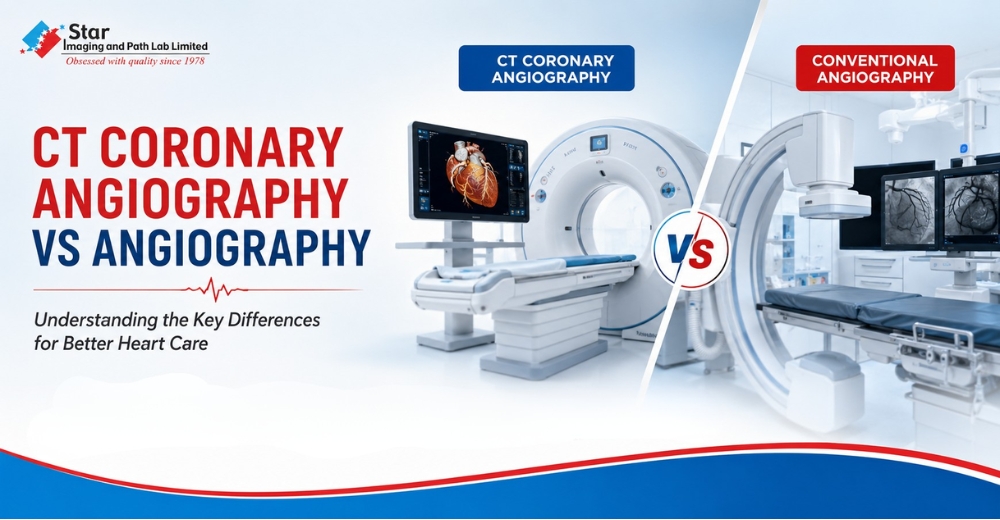
A CT Coronary Angiography is a non-invasive heart scan that uses an advanced Heart CT Scan to produce detailed images of the coronary arteries. Before the scan, a contrast dye is injected through a vein in your arm. The scanner then captures high quality images that help doctors detect plaque, narrowed blood vessels, and blocked arteries. Since no catheter is inserted into the arteries, the procedure is quick, comfortable, and patients can usually return home shortly after the scan.
A Conventional Coronary Angiography, also called Invasive Coronary Angiography, is performed in a Cath Lab. During the procedure, a thin catheter is inserted through an artery in the wrist or groin and guided towards the heart. Contrast dye is injected directly into the coronary arteries while X-ray images are taken. If a significant blockage is found, the cardiologist may perform angioplasty or place a stent during the same procedure if clinically required.
While both tests help diagnose coronary artery disease, they are not replacements for each other. One is mainly used to diagnose suspected blockages, while the other is often chosen when there is a possibility that treatment may also be needed.
CT Coronary Angiography vs Angiography: Quick Comparision
Procedure
-
CT Coronary Angiography: A non invasive CT scan that creates detailed images of the coronary arteries.
-
Conventional Coronary Angiography: An invasive procedure in which a catheter is inserted into an artery to examine the coronary arteries.
Catheter Required
-
CT Coronary Angiography: No catheter is required.
- Conventional Coronary Angiography: A catheter is required to reach the heart.
Contrast Dye
-
CT Coronary Angiography: Contrast dye is injected through a vein in the arm.
-
Conventional Coronary Angiography: Contrast dye is injected directly through the catheter.
Where It Is Performed
-
CT Coronary Angiography: Performed in the CT Scan Department.
-
Conventional Coronary Angiography: Performed in a Cardiac Catheterization Laboratory (Cath Lab).
Time Taken
-
CT Coronary Angiography: Usually completed in 10 to 20 minutes.
-
Conventional Coronary Angiography: Usually takes 30 to 60 minutes.
Recovery
-
CT Coronary Angiography: Most patients can return to their normal activities shortly after the scan.
-
Conventional Coronary Angiography: Patients require observation for a few hours before discharge.
Can It Treat a Blockage?
-
CT Coronary Angiography: No. It is only a diagnostic test.
-
Conventional Coronary Angiography: Yes. It can diagnose and treat blocked arteries through procedures such as angioplasty or stent placement.
Best Used For
-
CT Coronary Angiography: Detecting or ruling out coronary artery disease in people with suspected heart problems.
-
Conventional Coronary Angiography: Confirming significant coronary artery blockages and treating them when necessary.
When Do Doctors Recommend CT Coronary Angiography and When Is Angiography Needed?
The choice between these two tests depends on your symptoms, medical history, physical examination, ECG findings, and the likelihood of having significant coronary artery disease.
A cardiologist may recommend CT Coronary Angiography when the aim is to find out whether the coronary arteries have narrowing or plaque without performing an invasive procedure. It is commonly advised for patients who have chest pain, shortness of breath during activity, diabetes, high blood pressure, high cholesterol, or a family history of heart disease.
This scan is also useful when previous tests, such as an ECG or stress test, do not provide a clear answer. In many cases, it helps doctors rule out serious blockages and decide whether further treatment is necessary.
To understand whether this scan is suitable for you, read Who Should Get a CT Coronary Angiography.
Conventional Coronary Angiography is usually recommended when there is a strong suspicion of severe blockage, when symptoms suggest an ongoing heart attack, or when previous investigations indicate that a procedure such as angioplasty or stent placement may be required. Since treatment can be performed during the same procedure, it remains an important test in emergency and high risk situations.
CT Coronary Angiography/ Angiography: Which Test Is Right for You?
Many patients ask which test is better, but there is no single answer. The right investigation depends on why your doctor has advised the test.
If the goal is to diagnose coronary artery disease early and assess the condition of the coronary arteries without entering the body, CT Coronary Angiography is often the preferred first step. It provides detailed images, has a shorter recovery time, and is suitable for many patients with stable symptoms.
If there is already a high chance of a severe blockage or your cardiologist expects that immediate treatment may be needed, Conventional Coronary Angiography is generally the better option because it allows both diagnosis and treatment during the same sitting.
Suspected Coronary Artery Disease
- CT Coronary Angiography: Preferred first investigation in many patients.
- Conventional Coronary Angiography: May be recommended if severe disease is suspected.
Mild or Stable Chest Pain
- CT Coronary Angiography: Commonly recommended.
- Conventional Coronary Angiography: Usually not the first choice.
High Risk of Severe Blockage
- CT Coronary Angiography: May be advised first in selected patients.
- Conventional Coronary Angiography: Commonly recommended.
Suspected Heart Attack
- CT Coronary Angiography: Limited role.
- Conventional Coronary Angiography: Preferred investigation.
Possibility of Angioplasty or Stent
- CT Coronary Angiography: Cannot perform treatment.
- Conventional Coronary Angiography: Diagnosis and treatment can be done together.
Choosing the right test is always a medical decision. Your cardiologist considers your symptoms, risk factors, examination findings, and previous test results before recommending the most appropriate investigation.
If you would like to learn more about how the scan is performed, what to expect, and how to prepare, read our guide on CT Coronary Angiography.
Conclusion
Both CT Coronary Angiography and Conventional Coronary Angiography play an important role in diagnosing coronary artery disease, but they are recommended for different clinical situations. A CT Coronary Angiography is usually preferred when doctors need a detailed non invasive heart scan to evaluate the coronary arteries, while Traditional Angiography is generally advised when there is a high likelihood of severe blockage or a need for treatment such as angioplasty or stent placement.
At Star Imaging and path lab, our advanced cardiac CT technology provides detailed imaging that helps cardiologists make informed treatment decisions, ensuring patients receive accurate diagnosis and timely care. Book Your Appoinment.
Frequently Asked Questions
1. What is the main difference between CT Coronary Angiography and Angiography?
The main difference is that CT Coronary Angiography is a non-invasive CT scan that checks the coronary arteries using contrast dye, while Conventional Coronary Angiography is an invasive procedure that uses a catheter inserted through the wrist or groin. Conventional angiography can also be used to perform treatments such as angioplasty or stent placement if needed.
2. Which test is more accurate for detecting blocked coronary arteries?
Both tests are highly accurate when used for the right purpose. CT Coronary Angiography is excellent for detecting and ruling out coronary artery disease, while Conventional Coronary Angiography remains the gold standard when severe blockages are suspected or immediate treatment may be required.
3. Is CT Coronary Angiography safer than Conventional Angiography?
CT Coronary Angiography is generally considered safer for suitable patients because it is non-invasive and does not require a catheter to be inserted into the arteries. However, the safest and most appropriate test depends on your symptoms and your cardiologist's recommendation.
4. Can CT Coronary Angiography replace Conventional Angiography?
No. CT Coronary Angiography cannot completely replace Conventional Coronary Angiography. While it is an excellent diagnostic test, patients with severe blockages or those who need angioplasty or stent placement may still require Conventional Coronary Angiography.
5. How does a doctor decide which test I need?
Your cardiologist will consider several factors, including your symptoms, ECG or stress test results, medical history, risk factors for coronary artery disease, and whether there is a possibility that treatment may be needed immediately. Based on these findings, the most suitable test will be recommended.







.png)
.jpg)


Comments List